Sustainable architecture in Islington and Hackney: working with conservation and climate
22.09.26
Sustainable architecture in Islington and Hackney: working with conservation and climate
For historic homes in Islington and Hackney, improving environmental performance can sometimes appear to conflict with the character of the existing building. Conservation areas, listed buildings and Article 4 directions can place additional controls on external alterations, while local planning policies increasingly encourage measures that reduce energy use, support biodiversity and respond to climate change.
At Arboreal Architecture, we see this not simply as a conflict, but as a design challenge. The question is how sustainable improvements can be integrated carefully into existing buildings while retaining their architectural and historic qualities.
Net zero and conservation
Both Hackney and Islington have planning policies that support sustainable development, including measures relating to energy efficiency, renewable energy, urban greening and biodiversity. Hackney's Local Plan 2033 forms part of the development plan used to assess proposals in the borough, while Islington's planning framework includes specific policies supporting green roofs and solar roofs.
At the same time, conservation areas and listed buildings require the significance and appearance of heritage assets to be considered. In Islington, Article 4 directions have removed permitted development rights for certain alterations in many conservation areas, while Hackney also has Article 4 directions affecting some conservation areas and renewable energy installations.
This means that sustainable design needs to respond to both environmental and heritage considerations from the beginning of a project.
Islington Council Local Plan: Strategic and Development Management Policies
Islington Solar Panels Guidance
1. Considering visual impact
Solar panels, heat pumps, roof alterations and new windows can all affect the appearance of a historic property.
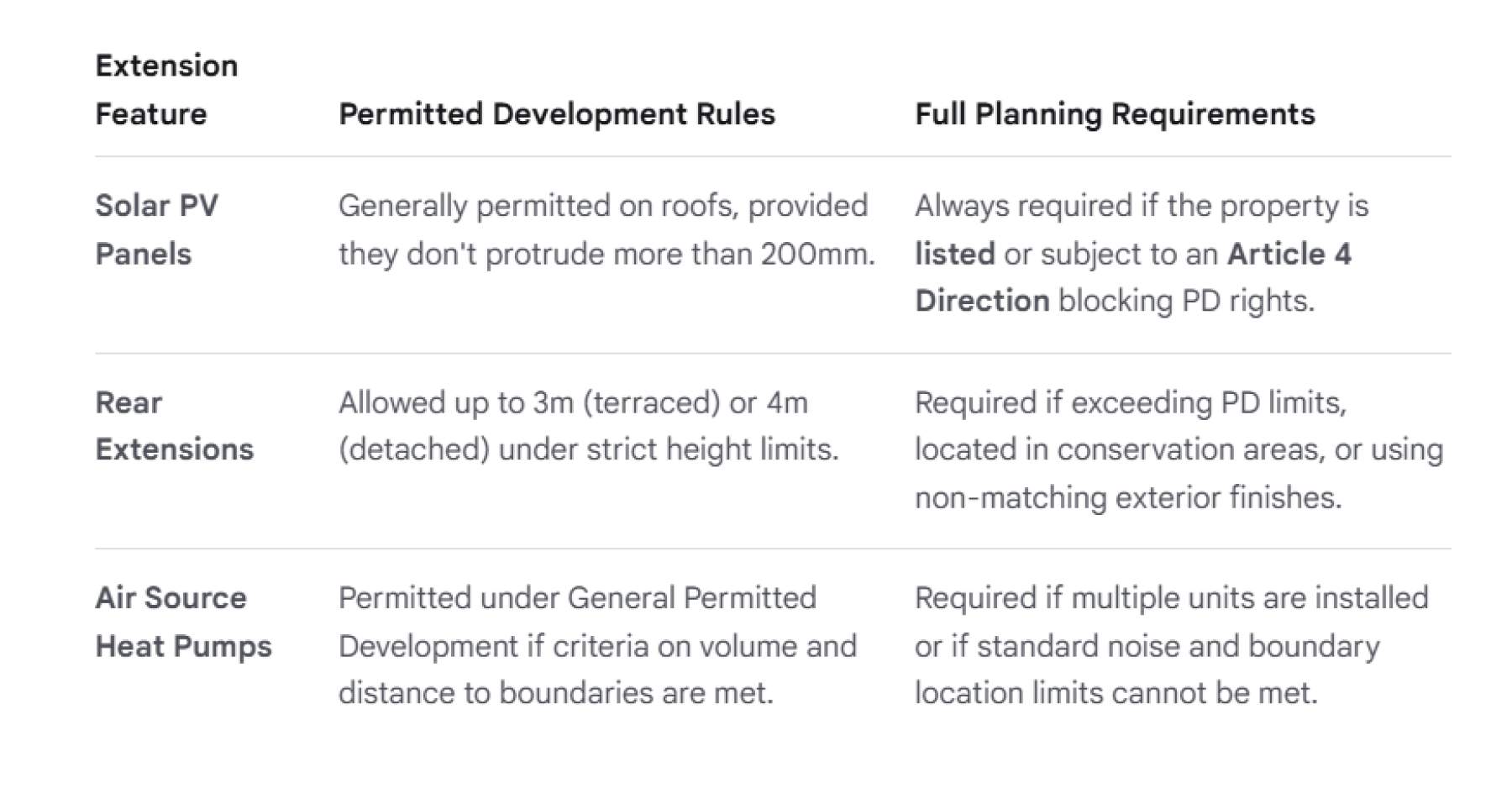
Where visibility from the street is an issue, the design can explore less visually prominent locations, such as rear roof slopes or carefully integrated roof forms. Solar panels, for example, may benefit from permitted development rights in some circumstances, but additional restrictions apply in conservation areas and to listed buildings. Islington's guidance specifically notes that panels on a wall fronting a highway in a conservation area do not benefit from the relevant permitted development right.
The important point is to consider the visual impact of environmental measures as part of the architecture rather than adding them at the end of the process.
2. Working with existing materials
Historic London houses often have carefully proportioned brick façades, timber sash windows, decorative details and established rhythms of openings.
A sustainable extension does not necessarily need to reproduce these elements literally. Contemporary materials can sit alongside an existing building while responding to its scale, proportions, texture and colour.
Low-embodied-carbon materials such as timber, lime-based finishes and other natural or responsibly sourced materials can form part of this approach. Their suitability depends on the construction, condition and environmental requirements of the individual building.
For retrofit, material compatibility is equally important. Improving thermal performance in an older building requires consideration of moisture movement, ventilation and the behaviour of existing construction, rather than simply adding insulation wherever possible.
3. Protecting daylight, gardens and biodiversity
Energy-efficient construction can require greater wall thicknesses because of additional insulation. Extensions therefore need to consider their effect on neighbouring properties, daylight and the existing garden.
At the same time, the roof and garden can become important parts of the environmental strategy.
Islington's current Climate Action SPD promotes green roofs and bio-solar roofs, with solar panels incorporated over green roof areas where appropriate. Green roofs can provide habitat, support biodiversity, contribute to sustainable drainage and help reduce overheating.
For a small urban site, these measures can make a meaningful contribution to the ecological performance of a project without requiring additional land.
Permitted development and planning permission
Not every sustainable home improvement requires a full planning application.
Some extensions, roof alterations and renewable-energy installations may fall within permitted development rights, although this depends on the property, location and proposed works. Conservation areas, Article 4 directions and listed-building status can significantly alter what is permitted.
Islington currently notes that permitted development rights have been removed for certain minor alterations in 40 of its 42 conservation areas. Hackney also has specific Article 4 directions that remove permitted development rights in designated areas, including for some renewable energy systems.
Understanding the planning context at the beginning of a project therefore allows the architectural and environmental strategy to develop together.
Designing for existing buildings
For Arboreal, sustainable retrofit is not about applying a fixed package of technologies to every house.
Each building has its own orientation, construction, materials, history and relationship to its surroundings. We consider these characteristics alongside energy use, embodied carbon, biodiversity and how the building is likely to be used in the future.
The result might involve a deep retrofit, a carefully detailed extension, improved glazing and insulation, renewable energy, natural ventilation, a green or solar roof, or a combination of these measures.
In conservation areas, good environmental design often depends on finding the right place and form for each intervention.
Rather than treating heritage and sustainability as opposing objectives, we see the existing building as the starting point for a lower-carbon future.
If you are seeking experienced Islington architects, please contact us to arrange an initial design session. Alternatively, view our portfolio of recent residential projects.
Contact us now on 07503 221 761 for a free 30-minute telephone consultation to discuss your project.